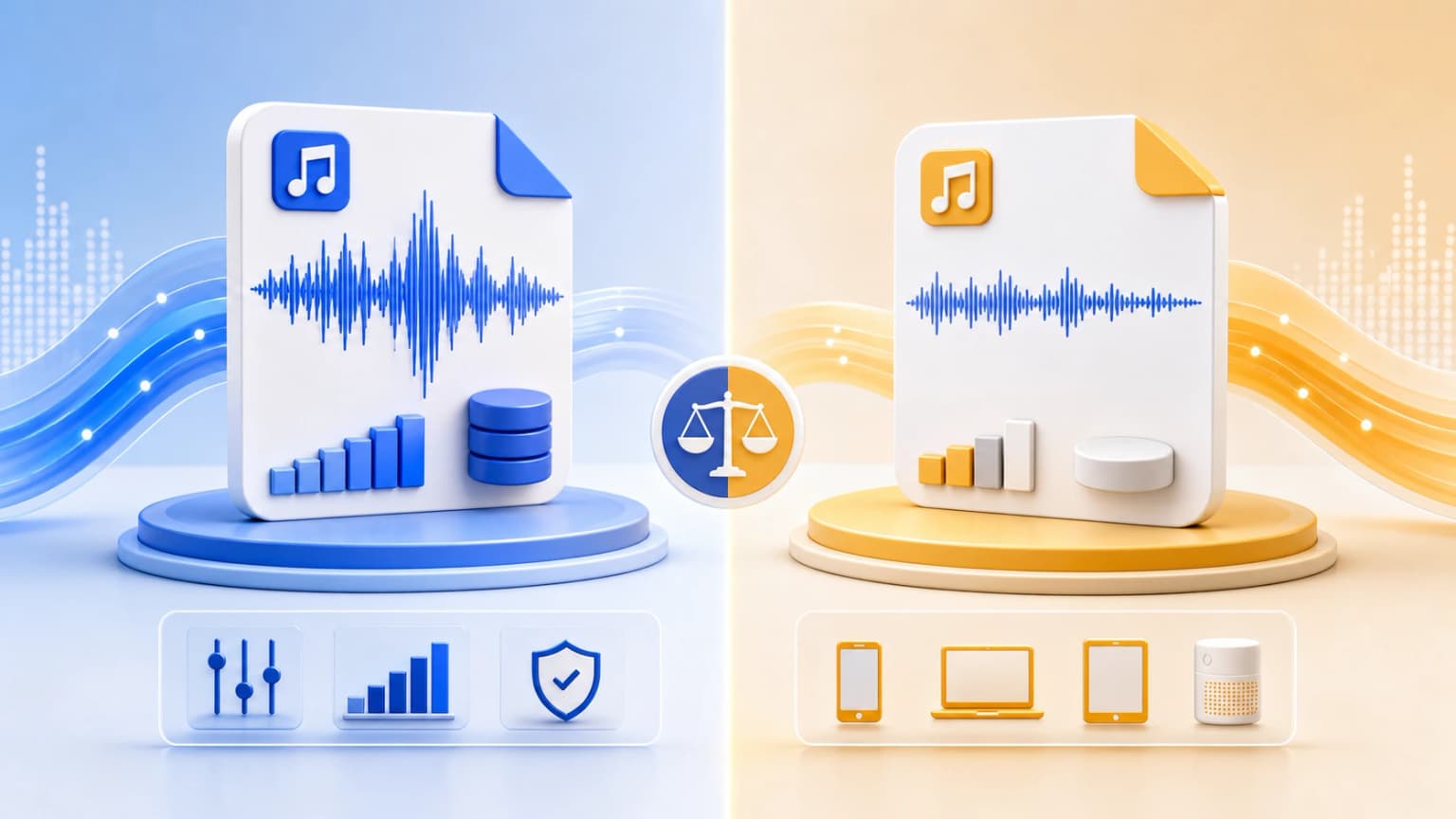
M4A and MP3 are two of the most popular lossy audio formats in use today. While MP3 has been the universal standard for digital audio since the early 1990s, M4A (using Advanced Audio Coding, or AAC) represents modern compression technology.
To understand why M4A generally sounds better than MP3 at identical bitrates, we must examine the architectural differences between their underlying audio codecs.
The Architectural Showdown: Codec Optimization
M4A files typically contain AAC audio, which was developed by a syndicate of technology leaders—including Dolby Laboratories, Fraunhofer IIS, and Sony—to replace and improve upon MP3. Here are the key technical advantages of AAC:
- Superior Frequency Band Resolution: AAC handles a wider range of vocal sampling frequencies (up to 96 kHz) compared to MP3's limit of 48 kHz.
- Flexible MDCT Block Sizes: AAC can dynamically scale Modified Discrete Cosine Transform (MDCT) block sizes between 128 and 1024 samples. This allows the encoder to capture sharp, fast transient sound waves (like cymbal hits and drum beats) with high precision, avoiding the temporal smearing artifacts common to MP3.
- Temporal Noise Shaping (TNS): This feature controls quantization noise across transient signals, preventing pre-echo distortion before rapid acoustic beats.
- Enhanced Joint Stereo Coding: AAC uses modern joint stereo techniques to optimize space, dedicating more bits to discrete panning parameters rather than duplicate mono information.
Side-By-Side Codec Feature Comparison
| Feature Block | M4A (AAC) | MP3 (MPEG-1 Layer III) | |
|---|---|---|---|
| Release Era | Late 1990s (Modernized continuously) | 1993 (Legacy framework) | M4A is far more modern |
| Frequency Limits | Up to 96 kHz | Up to 48 kHz | Higher clarity |
| Quantizer Bands | 48 critical frequency bands | Only 32 bands | Fine-grained modeling |
| Bitrate Efficiency | Excellent (Up to 30% smaller at equal quality) | Standard | Save device storage |
Verdict: When to Use Each Format
For digital archiving, editing, and day-to-day listening within modern software ecosystems (such as Apple Music, Android, and popular streaming apps), M4A is the clear winner. It delivers richer sound and smaller file sizes.
However, for universal compatibility—such as playing music in older vehicles, using legacy digital synths, or editing files in older software—MP3 is indispensable. It remains the most widely supported audio format in the world.